Ashtakavarga scores every house from 0 to 8 points (bindus) as seen by each of the seven classical planets, then sums them into one overall strength number per house. It is free.
Before you start
You need a saved chart with its calculations complete. Rahu and Ketu are not scored in Ashtakavarga — only the seven classical planets contribute and receive bindus.
Step 1 — Open Ashtakavarga Matrix
Open a saved chart and click Ashtakavarga Matrix in the sidebar, marked FREE. The page itself is headed "Ashtakvarga System" — a different spelling from the sidebar link, same feature.
Do not confuse this with the neighbouring Ashtakavarga Prediction link, a separate paid feature covering month-by-month transit windows.
Step 2 — Understand BAV versus SAV
Bhinnashtakavarga (BAV) is one planet's private view of every house, 0-8 bindus each. Sarvashtakavarga (SAV) adds all seven planets' BAV together for each house, giving one combined strength number. SAV is what "30+ strong, below 25 weak" refers to — a typical house averages around 28.
A higher SAV in a house means transits through that house will land harder, for better or worse. A low SAV house tends to give muted, delayed results even when transited by a normally strong planet.
Step 3 — Read the two main tables
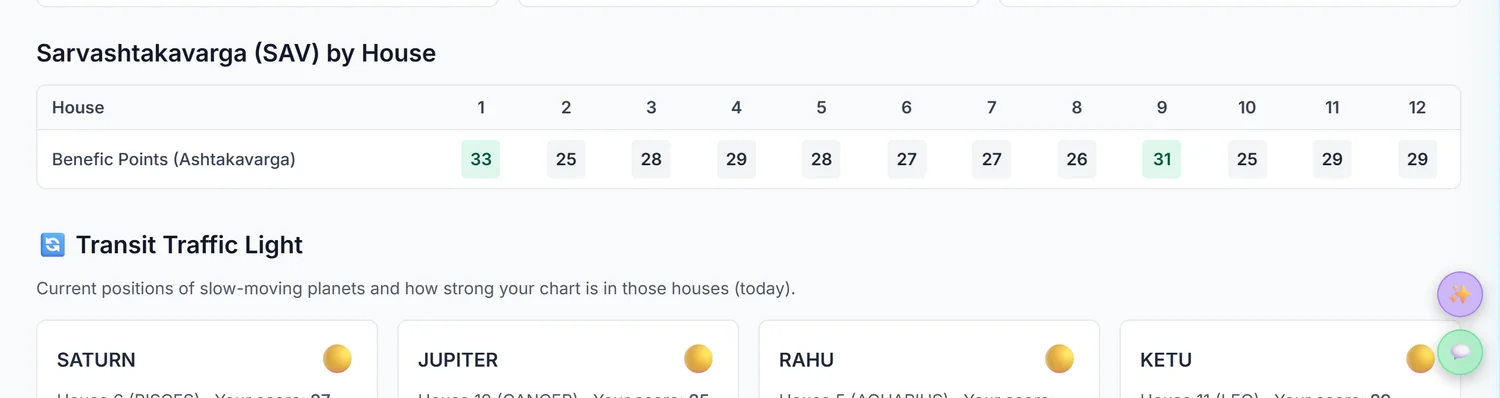
Sarvashtakavarga (SAV) by House is the summary: one bindu total per house, colour-graded green for strong, red for weak.
Bhinnashtakavarga (BAV) Matrix is the detail: every planet's own 0-8 score in every house. Use this when you need to know which specific planet is contributing the strength or weakness in a house, not just the combined total.
Step 4 — Use the Transit Traffic Light for current timing
Transit Traffic Light covers only the four slow-moving outer bodies — Saturn, Jupiter, Rahu, Ketu — because these are the ones gochar analysis usually tracks. It shows a green, amber or red verdict for wherever each one currently sits, based on that house's SAV score. Sun, Moon, Mars, Mercury and Venus move too fast for this static framing and are not shown here.
Step 5 — Read Directional Strength correctly
Directional Strength groups houses into four labelled directions: East (houses 1, 2, 12), South (3, 4, 5), West (6, 7, 8), North (9, 10, 11). These are a classical house-grouping convention, not compass directions from your birthplace — despite the recommendation text mentioning "direction," do not read this as literal geography.
A known gap: the Sodhya Pinda reference
One note on this page mentions "see Sodhya Pinda below for overall strength." Sodhya Pinda is not actually shown on this free page — it only appears in the separate paid Ashtakavarga Prediction report, under "Pinda Strength Analysis." If a client asks where Sodhya Pinda is on this page, the answer is that it isn't here.
Common mistakes
- Reading the SAV Total card as a single bindu score. It is the sum across all 12 houses, roughly 336 for an average chart — not a 0-8 or 0-56 figure.
- Treating Directional Strength as literal compass direction. It is a fixed house grouping.
- Looking for Sodhya Pinda on this page. It lives only in the paid Prediction report.
- Expecting the Transit Traffic Light to cover all nine planets. Only the four slow movers appear there.
If something goes wrong
- "Chart has no planetary data. Recalculate the chart first." Follow the Recalculate link on the same page.
- Transit Traffic Light section is missing entirely. It depends on a live ephemeris lookup that can occasionally fail; the section simply does not render rather than showing an error. Reload the page.